

Trade-based money laundering is not a niche quirk of trade finance; it is the dominant laundering method running through the global economy, hiding in plain sight in ordinary corporate behaviour, domestic SMEs, and open-account payments that almost nobody is looking at. The themes emerging from the case studies, interviews, and thesis are stark: regulators, banks, and technology vendors are collectively choosing what is easiest to police, not what is most harmful.
TBML is wider than trade finance
A clear theme is that practitioners understand TBML as “any money laundering that is effected through any trading activity between parties,” spanning retail, commercial, corporate, and industrial trade, yet regulation continues to treat it as a problem of documentary trade finance. Interviewees repeatedly stressed that sophisticated criminals avoid heavily controlled letters of credit and documentary collections, preferring open-account wires and domestic trade where there is minimal documentation and far fewer eyes on the transaction.
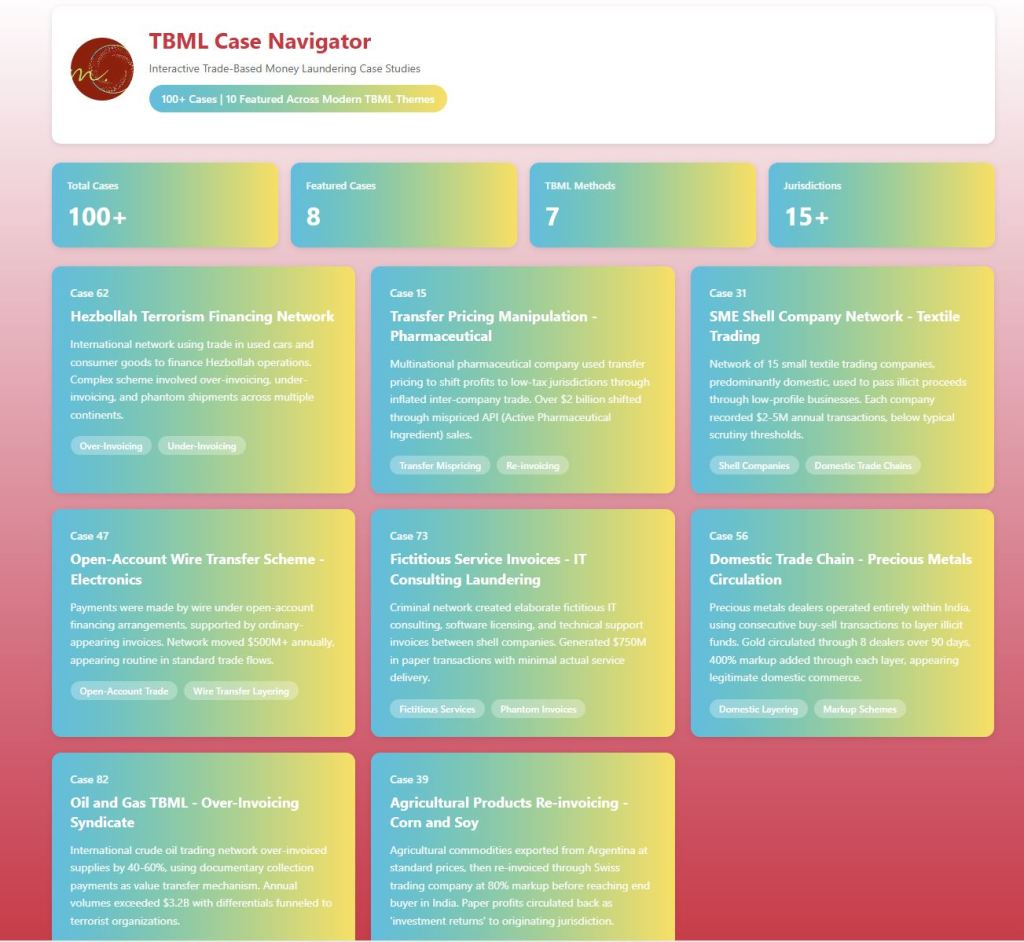
The case studies reinforce this breadth: TBML techniques underpin everything from drug proceeds and human trafficking to terrorism financing, corruption, VAT fraud, and corporate tax abuse, often by mixing illicit flows with ostensibly legitimate trade and service activity. Criminals do not think in FATF typology boxes; they combine cash, trade, hawala, services, crypto, and corporate structures in whatever mix best distances the money from the crime.
Open account and domestic trade: the real blind spot
Across interviews, a bold but consistent message emerges: if you wanted to launder money, you would not choose trade finance. Open-account trade—simple SWIFT payments referencing an invoice number—dominates global commerce, with estimates that roughly 80% of world trade settles this way, yet it attracts only generic transaction monitoring designed for retail flows. Banks often do not know what goods are being moved, who the end user is, or how the price relates to economic reality, making TBML detection on these flows “hugely difficult” in practice.
Domestic SMEs are another recurring vulnerability. Participants described networks of small, low‑risk‑rated businesses used as fronts for laundering, kept deliberately simple and “boring” so they never trigger traditional red‑flag rules or require trade finance products that would invite scrutiny. Until their volumes explode, these entities sit below the radar of both banks and regulators, even though they may be the primary conduit for large-scale domestic TBML.
Corporate tax behaviour and TBML: the forbidden overlap
One of the most challenging themes is the overlap between TBML techniques and corporate tax behaviour. Many of the same methods—transfer mispricing, re‑invoicing, round‑tripping, and complex intra‑group trade chains—are used both by criminals laundering drug or corruption proceeds and by multinationals shifting profits to low‑tax jurisdictions. Practitioners repeatedly voiced frustration that these practices are treated as “tax planning” when used by large corporates, even though the mechanics are indistinguishable from TBML and often meet the legal definition of money laundering when the tax dimension tips from avoidance into evasion.
Banks, however, are structurally unable to police this frontier. Interviewees emphasised that they lack visibility of tax liabilities, actual payments to tax authorities, and cross‑border group structures, and are therefore not in a position to determine where aggressive tax planning ends and criminal tax evasion begins. Without state‑led, cross‑jurisdictional data sharing and analytic capability, expecting banks to treat corporate tax behaviour as a TBML risk is both unrealistic and politically explosive.
Compliance technologies: built to tick boxes, not catch crime
The data depict a technology landscape optimised for regulatory comfort, not risk reduction. Banks primarily deploy tools to automate sanctions screening, KYC refresh, and document capture in trade finance, because these are the areas where regulators issue clear expectations and fines. Interviewees criticised most TBML “solutions” as repurposed retail AML tools that generate high false‑positive volumes and deliver little incremental insight over experienced human document checkers.
Where advanced tools such as entity‑resolution and network analytics are used, they tend to be bespoke builds at a handful of large institutions and are justified more on efficiency and “defensibility” than on demonstrated TBML interdiction. Emerging technologies with genuine potential—like privacy‑enhancing technologies that allow cross‑bank data pooling to see patterns in pricing, trade routes, and counterparties—are being piloted in a few forward‑leaning jurisdictions, but remain far from mainstream and are largely absent from the UK’s TBML response.
Regulators, enforcement, and the comfort of narrow definitions
A strong, uncomfortable theme is the misalignment of incentives. Practitioners describe regulators who insist TBML is fundamentally a trade finance issue, issue “Dear CEO” letters that reveal shallow understanding of how TBML actually operates, and cycle staff so frequently that difficult conversations about redefining TBML never progress. It is far easier to check whether a bank price‑checks invoices and dual‑use lists than to grapple with open‑account flows, domestic SME networks, or the tax behaviour of multinationals.
Law enforcement mirrors this pattern. TBML investigations are seen as slow, complex, low‑glamour, and risky from a career perspective, so resources flow instead to terrorism, sanctions breaches, and consumer fraud where arrests and asset seizures can be delivered quickly. Even when banks file trade‑related SARs, responses on money‑laundering suspicions can take years or never materialise, while sanctions‑related queries are answered in days—sending a clear signal about priorities.
Culture and knowledge: “nobody wants to rock the boat”
Underneath the structural issues sits a cultural theme: discomfort with challenge. Interviewees described conservative compliance leadership that prefers stable rule‑books and red‑flag lists over disruptive insights from ex‑law‑enforcement or technologists, even when those insights point to systemic blind spots. Ex‑police joining banks quickly learn that calling a profitable client “a criminal doing crime in your business” is not a career‑enhancing move.
Knowledge gaps reinforce this inertia. TBML remains “least recognised, understood and enforced,” and efforts to broaden the concept—into retail, commercial, service‑based, and barter TBML, and into domestic and corporate contexts—are often dismissed as too complex or too politically sensitive. Public‑private forums set up to share intelligence frequently fall back into traditional patterns: law enforcement asks banks to “check these names,” banks de‑risk instead of investigate, and nobody builds the richer typology and data ecosystem that a genuine risk‑based approach would require.
What the themes demand: a genuinely risk‑based TBML paradigm
Taken together, the themes from the cases, interviews, and thesis point to a necessary but uncomfortable shift:
- TBML definitions must expand beyond documentary trade finance to encompass open‑account trade, domestic trade, services, and corporate tax‑linked flows, anchored in how criminals and corporates actually move value, not in legacy typology lists.
- Regulatory incentives must move away from box‑ticking on trade‑finance controls and towards outcome‑focused expectations that reward credible detection across the full product and customer set where TBML risk actually sits.
- Technology investment needs to pivot from automating existing manual controls to enabling cross‑institution intelligence—through privacy‑preserving data pooling, better entity resolution, and analytics that can handle “too‑good‑to‑be‑true” accounts and complex intra‑group trade, not just easy retail scenarios.
- Public‑private collaboration must be re‑engineered from SAR dumping and name‑checking into genuine, iterative intelligence building, where banks, vendors, and law enforcement co‑design typologies and test them against pooled, privacy‑protected data.
The evidence across the TBML cases and doctoral research paints a picture of a system that is working very hard on the wrong things. Challenging that system—respectfully but firmly—means insisting that TBML policy starts with how trade actually works and how criminals actually behave, even when that leads straight into the messy territory of domestic SMEs, open‑account flows, and the tax games of the world’s most powerful corporations.


Leave a Reply