

Trade-based money laundering (TBML) represents one of the most significant yet paradoxical developments in modern economic crime enforcement. What emerged in the 1980s as obscure academic observations about bilateral trade discrepancies evolved into a multi-billion-dollar global compliance industry backed by international regulatory authority. Yet this remarkable transformation reveals troubling tensions between theory and practice, evidence and assertion, and regulatory power versus democratic accountability. Understanding TBML’s evolution is essential for comprehending contemporary financial governance and its fundamental legitimacy questions.
The Academic Foundations: Early Recognition (Pre-1990s)
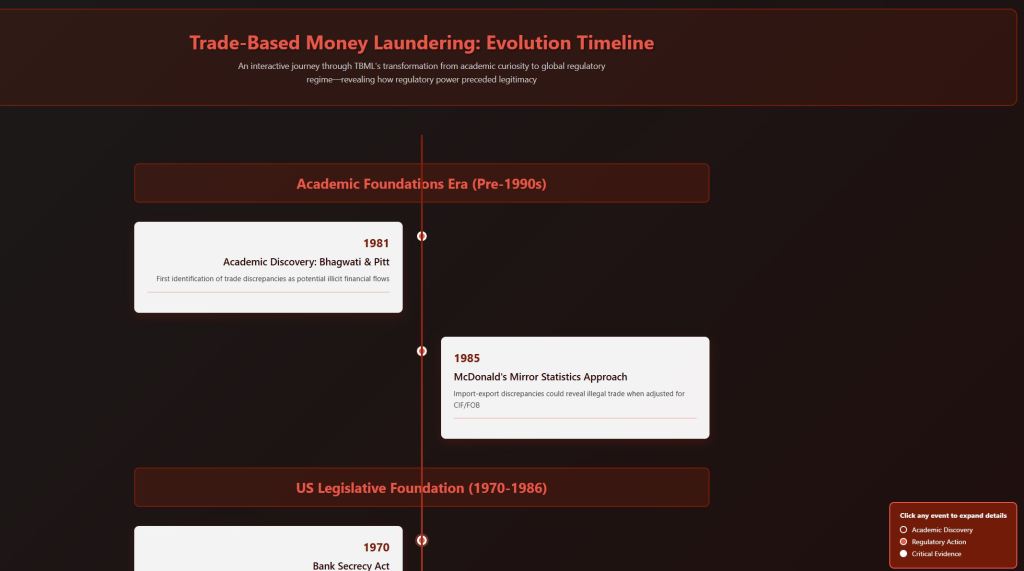
The phenomenon later termed “trade-based money laundering” existed long before formal regulatory recognition. Bhagwati (1981) and Pitt (1981) were pioneering figures who identified discrepancies in bilateral trade statistics as potential indicators of illicit financial flows. Their fundamental insight proved enduring: illegal financial flows require legitimate trade as camouflage, meaning the largest trade corridors would contain the most opportunities for criminal exploitation.
McDonald (1985) extended this analysis, hypothesizing that import-export discrepancies—when adjusted for insurance and freight costs—could reveal illegal trade activities. These early scholars established the intellectual foundation for detecting TBML through statistical analysis of trade data, yet their work remained largely confined to academic circles. The regulatory world seemed unaware or uninterested in what trade statistics revealed about criminal money flows.
The US Legislative Architecture (1970-1986)
American financial regulation began addressing illicit financial flows decades before TBML received formal recognition. The Bank Secrecy Act of 1970 represented the foundational legislation, requiring financial institutions to maintain records and file Currency Transaction Reports for transactions exceeding $10,000. However, implementation was notoriously weak. Banks either ignored requirements or deliberately circumvented them, and organized crime exploited these gaps systematically.
The Money Laundering Control Act of 1986 marked critical progress, explicitly criminalizing money laundering and introducing Suspicious Activity Reports (SARs) through the Annunzio-Wylie Anti-Money Laundering Act of 1992 . These laws created the basic framework for financial institution reporting, though they remained focused on traditional money laundering through banking channels rather than trade-based schemes.
The FATF Revolution: Formalizing International Authority (1989-1990)
The watershed moment came in 1989 when the Financial Action Task Force was established by the G-7 nations in Paris. This informal body emerged with remarkable speed and what observers describe as “evangelic zeal” about positioning money laundering as a serious global threat (van Duyne et al., 2018).
The FATF’s formation represented an unprecedented exercise in global financial governance. Within six months, this informal body issued its first 40 Recommendations in 1990, drafted with “extremely tight deadline and no academic input or consultation” (van Duyne et al., 2018). Remarkably, these “recommendations” functioned as mandatory requirements—the word “should” effectively meaning “must”—despite the FATF lacking formal treaty authority (van Duyne et al., 2018).
The creation of the FATF itself raised fundamental governance questions. As critical observers noted, the FATF assumed authority to set global standards without traditional sources of legitimacy: treaty authority, democratic accountability, or judicial review (van Duyne et al., 2018). Yet within years, its requirements became binding on virtually every financial system worldwide.
Quantifying TBML: The Zdanowicz Breakthrough (1990s-2000s)
While regulatory frameworks developed, academic research began quantifying TBML with precision. John S. Zdanowicz emerged as the dominant figure, developing methodologies to detect abnormal pricing in international trade. His work analyzed trade data at the 10-digit product code level, identifying transactions featuring abnormally high or low prices that suggested deliberate misinvoicing (Zdanowicz, 2004).
Zdanowicz’s (2004) estimates proved pioneering: approximately $175 billion entered the US through undervalued imports, while $112 billion exited through undervalued exports . His analysis of over 8,000 product categories revealed specific absurdities: bottles of ketchup priced at $50, footballs at $3,000, and Gucci watches valued at $100,000 listed as $50 Swatch watches (Zdanowicz, 2004).
These quantitative findings moved TBML from theoretical discussion to empirical evidence, demonstrating that trade-based schemes were not marginal aberrations but potentially massive financial flows. Zdanowicz’s 2005 founding of International Trade Alert institutionalized ongoing analysis of suspicious pricing patterns, establishing him as an internationally recognized expert.
FATF’s Formal Recognition: The 2006 Report
Despite early academic work, TBML received formal international recognition only in 2006 when the FATF published its landmark report titled “Trade Based Money Laundering”. This timing is striking—the regulatory apparatus was essentially “slow catching up behind the scholars” who had identified the phenomenon decades earlier.
The 2006 FATF report established several critical findings. TBML was identified as a significant channel for criminal activities, with global trade growth making it an increasingly important vulnerability. The report acknowledged that agencies such as customs, law enforcement, Financial Intelligence Units, tax authorities, and banking supervisors were “generally less equipped to identify and counter TBML compared to other money laundering forms,” partly due to limited understanding of techniques and information sharing limitations.
Notably, before the FATF’s 2006 formal recognition, “elements of TBML were understood and combated under different terminologies and within broader anti-money laundering efforts”. The report brought specific focus to the term and methodologies, establishing a common international framework.
The 2008 Best Practices: Operationalizing TBML Detection
Following the 2006 report, the FATF issued its first guidance paper for mitigating TBML in 2008. This best practices document aimed to improve competent authorities’ ability to collect and utilize trade data for detecting and investigating money laundering and terrorist financing through trade systems.
The guidance established several key principles. It recognized that as AML/CFT standards improved in other areas, TBML was becoming increasingly attractive to criminals seeking alternative channels. It called for risk-based approaches, comprehensive training programs tailored to different authorities, dissemination of TBML typologies and red flag indicators, and development of domestic and international cooperation mechanisms. Critically, the FATF advocated for the US Trade Transparency Unit (TTU) concept, encouraging countries to establish specialized units designated to monitor imports and exports, analyze trade data, identify anomalies, and support investigations.
The 2006 Federal Financial Institutions Examination Council updated its BSA Manual in response to the FATF report, requiring bank examinations to assess adequacy of systems managing trade financing risks. The private sector responded with the Wolfsberg Group’s Trade Finance Principles in 2009, updated substantially in 2019 in collaboration with the ICC and BAFT.
Academic Evolution: Gravity Models and Institutional Paradoxes (2010s)
The 2010s witnessed sophisticated academic modeling of TBML. Ferwerda et al. (2013) applied gravity models—traditionally used in trade economics—to estimate TBML flows. Their research tested whether bilateral money laundering flows could be predicted using economic size (GDP), distance, and institutional factors.
The gravity model approach revealed counterintuitive findings. TBML flows were highly related to licit trade volumes, confirming that larger trade flows created larger opportunities for fraud. However, countries with stricter anti-money laundering regulations experienced more trade-related money laundering, not less. Membership in the Egmont Group and hostile government attitudes toward traditional money laundering were positively correlated with TBML flows.
This finding suggested that “money launderers use TBML as an alternative for traditional money laundering when the country they send their money to is fighting the traditional form of money laundering intensively”. As financial system surveillance tightened, criminals migrated to trade channels—a finding that challenged the regime’s foundational assumption that more regulation equals less crime.
Balani et al. (2017) extended this research to Asian economies, examining how government attitude toward traditional money laundering affected TBML between Thailand, Singapore, and Japan from 2001-2015. Their findings confirmed the substitution hypothesis: TBML volumes increased with higher government prosecution rates for traditional money laundering.
Methodological Advances: Mirror Statistics and Precision (2010s)
Gara et al. (2019) made significant methodological contributions using mirror statistics—bilateral trade data comparisons between partner countries. Their innovation involved using point estimates for freight costs from the Bank of Italy survey rather than applying the standard 10% correction factor used throughout literature.
This precision mattered enormously. As Nitsch (2016) noted, “any difference in the observed cif/fob ratio above or below a value of 1.1 is interpreted as over-invoicing or under-invoicing, respectively. The assumption is arbitrary since, in practice, cif/fob ratios vary strongly, for various reasons”.
The Italian research team collected freight rate data at extremely detailed levels (6-digit product classification by partner country) and applied specific corrections rather than uniform adjustments. Their results revealed that anomalous trade flows were more frequent with EU and Euro area Member States and countries combining adequate opacity with high rule of law standards—criminals sought “safe havens” with institutional stability.
Definitional Debates and Legal Complexities
Throughout TBML’s evolution, fundamental definitional issues persisted. Unger’s (2007) structural linguistic analysis identified critical ambiguities in money laundering definitions. The subject could be money, proceeds, or property, with “the global consensus” distinguishing between “illegal money”—unreported to tax authorities—and “criminal money” from criminal behavior.
The goal variations also mattered: eight definitions focused on “hiding the illegal nature,” four on “making it appear legal,” and five combined both. Additionally, national legislations criminalized different predicate offenses. All crimes were criminalized in the Netherlands and Australia, while other countries specified minimum imprisonment thresholds or listed particular offenses. This lack of convergence created jurisdictional problems due to double criminality requirements—what constituted money laundering in Canada might not in Greece.
Scale and Impact: Contested Estimates
Estimates of TBML’s magnitude varied wildly and remained controversial:
– UNODC (2011): Criminal proceeds amounted to 3.6% of global GDP, with 2.7% ($1.6 trillion) laundered.
– Global Financial Integrity: Illicit trade flows in developing and emerging economies amounted to 14-24% of their total trade from 2005-2014, translating to over $1 trillion (Balani et al., 2027)
– Zdanowicz (2004): US TBML totalled $391 billion or 17% of total US trade.
However, significant methodological concerns surrounded these estimates. Van Duyne et al. (2018) argued that many estimates relied on “flawed statistics and lack of solid evidence”. Reuter flatly stated that “the quantitative results obtained from those exercises have no substantive meaning”. The Italian study by Gara et al. (2019) took a more modest approach, building risk indicators rather than attempting total estimates, acknowledging that discrepancies could arise from both criminal activity and legitimate factors.
The Compliance Industry Explosion
TBML regulation catalyzed development of a massive compliance industry. Banks developed three lines of defense: customer relationship managers (first line), Money Laundering Reporting Officers and financial crime teams (second line), and audit functions (third line).
An extensive ecosystem emerged including professional conferences, investigative consultancies (valued in the billions), third-party due diligence vendors, RegTech providers, and specialized publications. When banks failed compliance, they faced expensive remediation. Standard Chartered paid $700 million in fines plus $300 million in remediation costs, while HSBC paid $1.9 billion in fines and invested $680 million in 2,584 new compliance staff (van Duyne et al., 2018).
Critics describe this as a “multi-billion dollar industry” where consultants used “fear-based tactics” and “scaremongering survey reports” to drive sales[. The compliance regime created conflicts of interest—consulting firms that advise on compliance also profit from remediation when compliance fails.
Contemporary Challenges and Critical Perspectives
Recent literature highlighted persistent challenges and fundamental critiques. The FATF’s promised cost-benefit analysis, announced in 2008, was “silently dropped” and never conducted. Despite massive investment, evidence of regime effectiveness remained limited.
De-risking concerns emerged as banks refused customers from high-risk jurisdictions or sectors, potentially excluding law-abiding citizens. Risk-based approach limitations became apparent as regulators remained process-focused rather than outcome-focused. Banks preferred over-reporting to shift risk to regulators.
Most fundamentally, the FATF’s legitimacy came into question. An informal body functioned as binding authority without formal international legal status. The FATF’s blacklisting mechanism imposed sanctions without appeal rights or transparent evidence. As critics asked, “Does that mean that the FATF has become in its field a higher authority than the UN? And if so, with what authority?” (van Duyne et al., 2018).
The FATF reported only to G-7/G-20 ministers, not to affected countries or the public funding its operations. It operated as “investigator, judge and executioner at the same time, ignoring the basic rule of division of power”.
Geographic Patterns and Safe Haven Paradoxes
Empirical research revealed geographic paradoxes. TBML was more frequent between major trading partners—confirming Bhagwati’s insight that illegal trade requires substantial legal trade as camouflage. Yet money wasn’t kept in offshore centers with poor AML controls; rather, it flowed into major financial centers (US, UK) for investment in countries with weaker controls.
Baker (2005) found that “for every dollar sent to developing countries for development aid, 10 dollars flow back to developed countries in the form of money laundering and illicit capital flight”. This highlighted TBML’s devastating impact on economic development for precisely those nations most dependent on honest trade revenues.
Conclusion: A Regime in Question
The TBML regime evolved from academic observation to global regulatory priority—a remarkable transformation exhibiting troubling features. Theory-practice gaps persisted, with academic research often contradicting regulatory assumptions. Definition instability remained after decades, with basic concepts lacking international convergence.
Evidence deficits were fundamental. Magnitude estimates rested on questionable methodologies, and the regime operated with limited empirical validation of effectiveness. Institutional anomalies were severe: an informal body wield unprecedented power over sovereign states without traditional legitimacy sources.
The regime’s distributional consequences fell heavily on developing countries while de-risking excluded vulnerable populations. As the 2006 FATF report acknowledged, agencies remained “generally less equipped” to detect TBML, yet billions were invested in compliance systems of uncertain effectiveness.
TBML’s history suggests that regulatory power came first, legitimacy later—if at all. The field now demands critical questions: Does the regime actually reduce crime or merely redistribute it? Do benefits justify compliance costs? Can an accountable, evidence-based TBML framework be designed?
These questions concern the allocation of trillions in global resources, the scope of sovereign authority, and ultimately, whether international financial governance can be both powerful and legitimate. The answers will define not only TBML enforcement but the future of global financial regulation itself.
Check out this Interactive TBML Evolution Timeline


Leave a Reply